
Orchestrated Alliance: Exposing the Trust Fall in the NYC Ride-hail Circuit
Orchestrated Alliance: Exposing the Trust Fall in the NYC Ride-hail Circuit
Trust Fall: How Workplace Relationships Fail Us shows how workers in professional offices and interactive service settings come to rely on interpersonal ties as improvised infrastructures for navigating insecurity. The trust that emerges feels sustaining but often binds workers more tightly to unequal and opaque organizational systems.
The book’s final empirical chapter examines a different configuration of workplace relations in the NYC ride-hail circuit. Governed by algorithmic management and organized around solitary labor, the ride-hail environment would seemingly be the last place where coworker relationships would be relevant. Yet, this is precisely where the debilitating patterns of the “trust fall” of modern work begin to fracture.
Rather than leaning on interpersonal vulnerability, drivers forge connections through a shared sense of structural position, one grounded in class consciousness, collective grievance, and a refusal to accept the status quo. These forms of solidarity unsettle the patterns observed in other settings and highlight the political possibilities that emerge when workers redirect their relational commitments away from organizational hierarchies and toward one another.
Moral Repair
“I find the people who are struggling a lot are more interesting [than those in positions of privilege or power],” driver Gabe said, his voice steady but reflective. “They’re more connected to the reality of what’s really going on.” For Gabe, staying in an exploitative industry rather than escaping to something “safer” wasn’t about stubbornness; it was about refusing to settle for the status quo. “Even though things are tough,” he continued, “just the idea that you have somebody that’s willing to fight with you is a comforting thing.” Describing his engagement with the labor organization, IDG (Independent Drivers Guild), he said, “It gave me a sense of, okay, there is an organization that I can belong to that is actually trying to help.” “Whenever I find those people in my life,” he added, “it makes me feel good.” He laughed self-consciously as if surprised by his own feelings. “I don’t want to be emotional, but it makes me feel good.”
At The Jones, DTC, and Disruption, people forged trust amid adversity, bonding through a shared embrace of vulnerability. Through the morality of the fallen, suffering—and the resilience it demanded—emerged as potent social currency, elevating individual reputations and marking the boundaries of belonging. Yet as shown in chapter 2, these bonds had a stabilizing effect on the workplace, legitimizing dysfunction as useful and perpetuating cycles of hardship (and even abuse) as a rite of passage.[1]As is likely clear by now, the morality of the fallen parallels Nietzsche’s “slave morality” in elevating suffering as meaningful but operates instead as a mechanism of connection rather than … Continue reading In the NYC ride-hail circuit, drivers like Gabe reimagined suffering, treating it not as a means of fortification but as a catalyst for change.
Poor work conditions were not a cross drivers would bear. Instead, they interpreted those conditions as signs of erosion and decay in the infrastructure of work—problems that demanded maintenance, repair, and revision. Science and technology studies scholar Steven Jackson argues that a focus on repair transcends the binary of nostalgia versus novelty, rejecting the fetishization of both the past and the future. It foregrounds an ethic of care, seeking sustainability through a balance of preservation and transformation.[2]Steven Jackson, “Rethinking Repair,” in Media Technologies: Essays on Communication, Materiality, and Society, eds. Tarleton Gillespie, Pablo Boczkowski, and Kirsten A. Foot (The MIT Press, 2014). Drivers like Gabe embraced a similar approach—moral repair—by advocating and organizing to bring about meaningful change to their working conditions, reframing suffering as a collective call to action.[3]Feminist scholar Margaret Urban Walker defines moral repair as restoring trust after harm, while I align with Jackson’s focus on the ongoing work of maintaining and transforming social systems. … Continue reading
Platform drivers occupied a unique vantage point that allowed them to see the shortcomings of both traditional and emerging forms of work and made them particularly attuned to the need for repair. Those who’d been driving for years knew the underbelly of the taxi industry: the exploitative fleet owners who squeezed every dollar from drivers and, more recently, the predatory lenders who dangled medallion ownership as a lifeline, only to drown drivers in debt.[4]Graham Russell Gao Hodges, Taxi! A Social History of the New York City Cabdriver (Johns Hopkins University Press, 2007); and Diditi Mitra, “Driving Taxis in New York City,” WorkingUSA 7, no. 2 … Continue reading Others came to the job from different fields, burned out by what traditional employment had become. Cal, for example, had grown “disgusted working a nine-to-five job” after repeatedly confronting discriminatory practices and managers. Angel, who previously worked in security, described how that job took over her life. “They would call me to work for everything,” she said. “I was basically working seven days [a week]. I didn’t have time for myself.” For Durene, ride-hail driving was a last resort after being laid off from her clerical job. Despite decades of experience, she found herself excluded from the job market. “They’re more focused on cutting costs, not the quality of life for employees,” she said quietly.
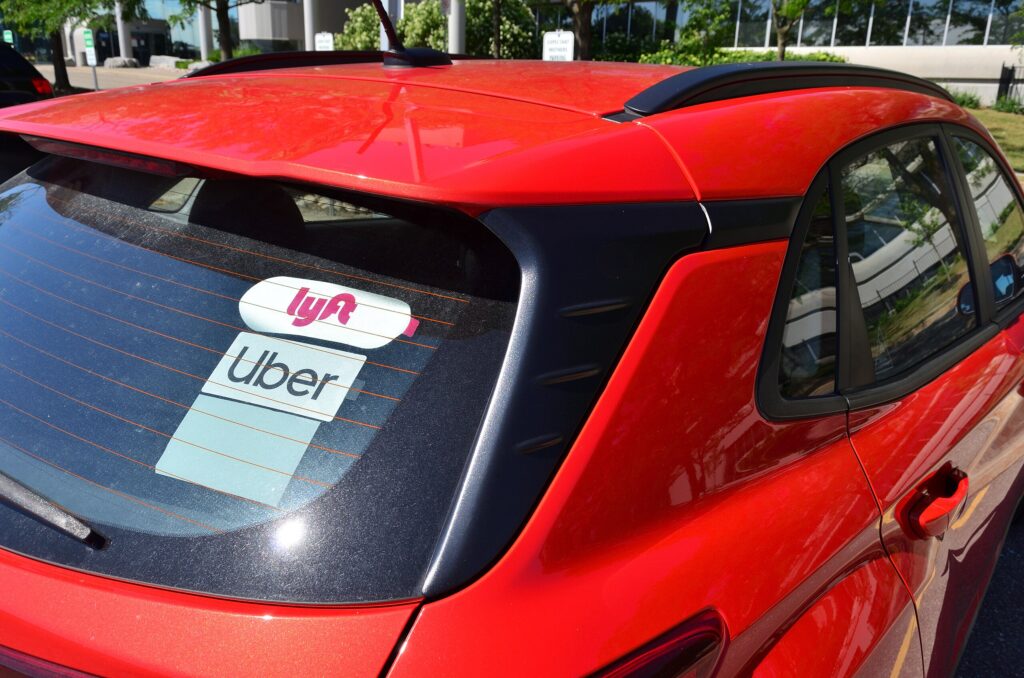
Drivers like these had experienced the erosion of US work conditions firsthand. They saw the social contract unraveling—work demanded more but returned less—and were wary of platforms claiming to offer a way out. Companies like Uber and Lyft initially marketed themselves as saviors. “[They] used to advertise more time with your family, more money in your pocket,” Greg recalled, while Gabe remembered hearing the promise of “being your own boss and being able to make your own schedule.” For a while, platforms appeared to deliver on these promises. Their steady but flexible offer of work was a particularly welcomed lifeline in the aftermath of the Great Recession’s devastation. Gabe could take his daughter to therapy on weekdays—something a traditional job never allowed—while pulling in a six-figure salary. Gloria, a single mom of four, managed to balance caregiving and work, a feat she hadn’t thought possible.[5]For more on the benefits and constraints of flexibility in the gig economy, refer to Lisa Gulesserian, Alex Veen, and Marian Baird, “‘Gig’ Work and Fatherhood: A Typology of Ride-Share Fathers … Continue reading But as the market matured and platforms slashed rider fares to remain competitive, those same drivers saw paychecks shrink and their flexibility erode. Gabe, for example, said his earnings had plummeted—from $130,000 in 2012 to less than $40,000 in 2016—even though his hours stayed the same.
Unwilling to return to traditional work and disillusioned by platform providers’ promises about the “future of work,” drivers began to organize. “[Drivers] have community with one another,” Tim told me, “like a solidarity feeling.” Solidarity, he explained, was not rooted in “emotional trust” but in something more concrete: the belief “that they’re going to do something, right?” Indeed, drivers who began getting involved with IDG expressed a wariness about trust, revealing just how contaminated appeals to it had become. Angel, who was contemplating membership, admitted, “I don’t trust nobody. Who knows if these major companies are the owners of IDG,” while George asked skeptically, “I mean, who can you trust?”[6]There were valid reasons for their reticence given the IDG’s formal ties to Uber at the time. Noam Scheiber, “Uber Has a Union of Sorts, but Faces Doubts on Its Autonomy,” New York Times, … Continue reading
This skepticism was on full display when I met Fahad at a LaGuardia Airport lot, where he was recruiting drivers for IDG. As we approached a group of ten drivers perched on tailgates, killing time between rides, they started cracking jokes when they saw Fahad’s IDG pin. “What makes IDG different?” one of them asked, while another questioned the point of even staying in the industry. Fahad leaned into their frustration. “Do you think drivers have a problem?” he asked, his voice calm but insistent. The drivers exchanged annoyed glances—of course there were problems. Fahad pressed on: “What are our problems?” His question opened a valve and the grievances poured out: low fares, platforms’ high commissions, and the regulators’ aggressive ticketing were among the many issues mentioned. Fahad listened carefully before asking, “Who will solve these problems?” When someone quipped, “IDG will,” Fahad shook his head. “No. We have to solve them together.”
While Fahad only signed up a handful of drivers that day, the IDG’s efforts were beginning to resonate. Drivers like George could point to tangible wins. “They’ve done a lot,” he said, ticking off accomplishments like campaigns that pressured platforms to add tipping features and destination filters to the apps. “They’re trying to improve the ride-sharing business because, right now, it’s not great.” Gail echoed this sentiment, but her reasoning struck a deeper, moral chord. “I’m going through a lot of personal stuff,” she explained, “but I decided, why am I going to keep going through my personal things where maybe if I fix whatever is going on around in the world [. . .] then I could at least get that fixed.” Her words came haltingly, as if testing out a fragile logic. “It’s not just you going through it, you know?” she continued, plugging her personal problems into a collective framework. For drivers like Gail, moral repair offered more than just a connection: It offered purpose and a meaningful path forward.
The ethos of moral repair was evident in the drivers’ fight for an in-app tipping option, a feature Uber in particular had long resisted.[7]Drivers frequently commented on Uber’s discouragement of tipping; Diego, for example, told me, “They’ve invested more money into telling the customers no tipping. Right? You saw the video. … Continue reading In coordination with the IDG, drivers launched a citywide public awareness campaign, drawing attention to their demands and building public pressure. In February 2017, IDG then formally petitioned the TLC (Taxi & Limousine Commission) to mandate the feature.[8]Independent Drivers Guild (IDG), “On Tipping,” IDG, accessed November 25, 2024, https://driversguild.org/on-tipping/. At hearings that spring and summer, scores of drivers testified, sharing stories of grueling hours and dwindling pay and demanding a system that reflected their worth.[9]Full hearing transcripts are available on the TLC’s Commission Meeting page.
By the end of the year, the TLC passed the rule, making in-app tipping a requirement across all platforms.[10]Taxi & Limousine Commission (TLC), “Notice of Promulgation of Rules on Tipping,” 2017, https://www.nyc.gov/assets/tlc/downloads/pdf/proposed_tipping_rule_promulgated.pdf. “Today’s victory is more proof that thousands of drivers coming together with one voice can make big changes,” driver and IDG member Jose said on the day the TLC approved the petition.[11]Independent Drivers Guild (IDG), “The Independent Drivers Guild Celebrates Tipping Victory over Uber,” IDG, April 17, 2017, … Continue reading But the battle wasn’t over. Labor activist Tina recalled how Uber rushed to implement its own version of the tipping feature before the rule took effect.[12]Andrew Hawkins, “Uber Finally Caves and Adds a Tipping Option to Its App,” The Verge, June 20, 2017, … Continue reading “They tried to take the wind out of our sails,” she said. Still, drivers weren’t deterred, shifting their focus to bigger demands like pushing for 20, 25, and 30 percent tip options rather than the paltry $1, $3, and $5 options Uber was offering.
As evident in their tip option initiative, drivers didn’t confine their calls for moral repair to one another; they broadcast them across the diverse participants in the ride-hail circuit. They testified in public hearings, blogged about their experiences, and shared their struggles with journalists and researchers—anyone willing to listen.[13]At times, these precarious alliances backfired. Wells and colleagues, for example, describe how a journalist outed drivers who were tricking the platform apps by turning their phones off and on in … Continue reading In a 2018 Forbes article, for example, Uber driver Henry declared, “People talk about sweatshops in other countries, but they don’t realize there’s a big sweatshop in every US city. Drivers are working at least 10 to 15 hours a day every day, drivers are dying, and I think that’s also a tragedy.”[14]Janet Burns, “Amid NYC Suicides, Drivers Urge Lawmakers to End Uber’s Exploitative Ways,” Forbes, March 20, 2018, … Continue reading By making their grievances public, drivers forced others—providers, regulators, riders, and society at large—to bear witness to their suffering, imparting on them a moral obligation to enact change.[15]Sarah Mosseri, “Being Watched and Being Seen: Negotiating Visibility in the NYC Ride-Hail Circuit,” New Media & Society 24, no. 3 (March 1, 2022): 600–620, … Continue reading
As drivers made their grievances public, they challenged not only the platforms but also the complicity of those who benefited from their exploitation. Fahad addressed the issue directly, turning to me as a symbolic stand-in for all riders. “You want a cheap ride,” he said, “but you’re not thinking about what you are actually doing. You are feeding this big corporation who is depriving and taking—you know, violating all the rights from the drivers.” He articulated a moral standard: “If one person is treated bad—could be African American, could be Hispanic, immigrant, or driver—that means we [in society] still have to do our work. That means we are not up to par.” For Fahad and others who’d been burned by both traditional and emerging work forms, this was about more than one-off worker demands. It was about confronting the systemic injustices underpinning the US economy—a moral reckoning that was long overdue.
This excerpt is reproduced with permission from a book entitled Trust Fall: How Workplace Relationships Fail Us by Sarah Mosseri, published by the University of California Press, 2025.
Footnotes
| ↑1 | As is likely clear by now, the morality of the fallen parallels Nietzsche’s “slave morality” in elevating suffering as meaningful but operates instead as a mechanism of connection rather than envy or resentment. Friedrich Nietzsche, On the Genealogy of Morality, ed. Keith Ansell-Pearson, trans. Carol Diethe (1887; Cambridge University Press, 2017). |
|---|---|
| ↑2 | Steven Jackson, “Rethinking Repair,” in Media Technologies: Essays on Communication, Materiality, and Society, eds. Tarleton Gillespie, Pablo Boczkowski, and Kirsten A. Foot (The MIT Press, 2014). |
| ↑3 | Feminist scholar Margaret Urban Walker defines moral repair as restoring trust after harm, while I align with Jackson’s focus on the ongoing work of maintaining and transforming social systems. Margaret Urban Walker, Moral Repair: Reconstructing Moral Relations After Wrongdoing (Cambridge University Press, 2006). |
| ↑4 | Graham Russell Gao Hodges, Taxi! A Social History of the New York City Cabdriver (Johns Hopkins University Press, 2007); and Diditi Mitra, “Driving Taxis in New York City,” WorkingUSA 7, no. 2 (2003): 76–99, https://brill.com/view/journals/wusa/7/2/article-p76_6.xml. |
| ↑5 | For more on the benefits and constraints of flexibility in the gig economy, refer to Lisa Gulesserian, Alex Veen, and Marian Baird, “‘Gig’ Work and Fatherhood: A Typology of Ride-Share Fathers in Australia,” New Technology, Work and Employment 40, no. 3 (November 2025): 564–574, https://doi.org/10.1111/ntwe.12333, and Al James, “Platform Work-Lives in the Gig Economy: Recentering Work–Family Research,” Gender, Work & Organization 31, no. 2 (2024): 513–34, https://doi.org/10.1111/gwao.13087. |
| ↑6 | There were valid reasons for their reticence given the IDG’s formal ties to Uber at the time. Noam Scheiber, “Uber Has a Union of Sorts, but Faces Doubts on Its Autonomy,” New York Times, January 20, 2018, https://www.nytimes.com/2017/05/12/business/economy/uber-drivers-union.html#:~:text=Uber%20was%20a%20pioneer%20in,as%20well%20as%20Uber’s%20money. |
| ↑7 | Drivers frequently commented on Uber’s discouragement of tipping; Diego, for example, told me, “They’ve invested more money into telling the customers no tipping. Right? You saw the video. ‘No tipping.’” |
| ↑8 | Independent Drivers Guild (IDG), “On Tipping,” IDG, accessed November 25, 2024, https://driversguild.org/on-tipping/. |
| ↑9 | Full hearing transcripts are available on the TLC’s Commission Meeting page. |
| ↑10 | Taxi & Limousine Commission (TLC), “Notice of Promulgation of Rules on Tipping,” 2017, https://www.nyc.gov/assets/tlc/downloads/pdf/proposed_tipping_rule_promulgated.pdf. |
| ↑11 | Independent Drivers Guild (IDG), “The Independent Drivers Guild Celebrates Tipping Victory over Uber,” IDG, April 17, 2017, https://driversguild.org/independent-drivers-guild-celebrates-tipping-victory-uber/. |
| ↑12 | Andrew Hawkins, “Uber Finally Caves and Adds a Tipping Option to Its App,” The Verge, June 20, 2017, https://www.theverge.com/2017/6/20/15840818/uber-tipping-option-app-seattle-minneapolis-houston. |
| ↑13 | At times, these precarious alliances backfired. Wells and colleagues, for example, describe how a journalist outed drivers who were tricking the platform apps by turning their phones off and on in unison to manipulate dynamic pricing systems. Katie Wells, Kafui Attoh, and Declan Cullen, “‘Just-in-Place’ Labor: Driver Organizing in the Uber Workplace,” Environment and Planning A: Economy and Space 53, no. 2 (March 1, 2021): 315–31, https://doi.org/10.1177/0308518X20949266. Similarly, media outlets reported in 2022 that Uber paid academic researchers to feed favorable research to the media. For example, Felicity Lawrence, “Uber Paid Academics Six-Figure Sums for Research to Feed to the Media,” The Guardian, July 12, 2022, https://www.theguardian.com/news/2022/jul/12/uber-paid-academics-six-figure-sums-for-research-to-feed-to-the-media. In my own interactions with drivers, many expressed an initial wariness, explaining they’d been burned by undercover platform providers, cops, and even journalists in the past. |
| ↑14 | Janet Burns, “Amid NYC Suicides, Drivers Urge Lawmakers to End Uber’s Exploitative Ways,” Forbes, March 20, 2018, https://www.forbes.com/sites/janetwburns/2018/03/20/after-nyc-suicides-drivers-groups-urge-lawmakers-to-handle-uber-for-good/. |
| ↑15 | Sarah Mosseri, “Being Watched and Being Seen: Negotiating Visibility in the NYC Ride-Hail Circuit,” New Media & Society 24, no. 3 (March 1, 2022): 600–620, https://doi.org/10.1177/1461444820966752. |