
Bringing Communities into the Loop: A Conversation with Jameila “Meme” Styles
Bringing Communities into the Loop: A Conversation with Jameila “Meme” Styles
With the proliferation of artificial intelligence software and applications, advocates for data security, ethics, and responsible digital governance have pushed for human-in-the-loop safeguards to protect the public. However, this approach can potentially ignore the most vulnerable. In this interview, Program Associate Carmina Rangel-Pacheco talks with Meme Styles, 2022 Just Tech Fellow and the founder of Measure, about the limits of human-in-the-loop approaches and Styles’s own proposition for creating stronger and more comprehensive AI and digital safeguards: the theory of interrogated reasoning. Here, she explains this approach and how it came to be.
Carmina Rangel-Pacheco (CRP): To begin our interview, could you take a moment to introduce yourself and talk a little bit about your work with Measure?
Meme Styles (MS): Yeah, for sure. My name is Meme Styles, and that is my real name. That is why I married my husband. I met my husband when I was 14 years old, and I went up to him and I asked, “What’s your name?” He said, “My name is Cliff Styles.” And I said, “I’m going to marry you for your last name.” And I did. I’m telling you this story because I think it shows who I am as a person. I’m an incredibly intentional human being, and I have been since youth.
I’m the president and founder of a research and data activism organization called Measure. We are based in Austin, Texas, and I get to work alongside the most brilliant women of color every single day as we work to just elevate lived experience as data, as we work to redefine the data that tries to define our lives, as we interrogate the presence of robots, as we push back on algorithmic harm in exchange for community-led protocol, community-created antibias methodology, and redefine traditional research. We ensure that our community’s voices and our expertise is truly valued in the tech space.
CRP: In 2022, you were part of Just Tech’s first fellowship cohort. What have you been up to since your fellowship term ended?
MS: Gosh, so much. The Just Tech fellowship and my cohort gave me the permission that I needed to expand. I remember our first event together as a cohort was our retreat up in the Catskill Mountains. The first thing they did was give us space to just think, to reflect, and to connect with one another. When I was up there in the mountains, I looked outside the window and saw how the trees and mountains were big and expansive, and no one had to give them permission to grow. They just did. They flowed with the breeze and the air, and nothing was there governing that beauty and that oneness with nature. I looked at that and I said, “Wow, who ever told me that I couldn’t? Who told me that what I do is supposed to be constrained?” It gave me an opportunity to expand and to think outside of the box. I’m already a person that thinks like that, but it gave me the opportunity to really home in, to embrace my neurodiversity, and to celebrate it with other people that were like-minded.
Since then, I’ve been able to take an idea, which became my platform Ignite, and create it to be a community of people working together, thinking together, and solving problems together. Along the way, we’ve also been able to really hone into the idea that we should have power over robots, over AI. I’ve positioned myself as a person that is now interrogating artificial intelligence, but I am also incorporating artificial intelligence into Ignite. We have over 350 community members on it right now. We’re working together, we’re building together, and we’re also interrogating artificial intelligence together.
CRP: I understand that you are in the process of developing what you refer to as the “theory of interrogated reasoning for better AI.” Could you tell me more about the experiences and research you drew from to develop this theory?
MS: Let me start with the reasons why I developed this theory. Policy on AI governance and guardrails is moving very, very fast, but unfortunately, communities are being brought in too late into the governance puzzle, if at all. I also serve as the chairwoman of the HBCU AI Conference and as the vice president of Responsible and Ethical AI for Austin AI Alliance. I’m in rooms with a bunch of tech bros, and I’m also in rooms with Black academics. And I’m having different sets of conversations that are in many ways conflicting with one another. On the tech bros side, they say, “What are we doing with governance? It’s important, but only so important.” And on the academia side with HBCUs, it’s very important that tech and tools are ethical and responsible.
At the same exact time, cities around the world are deploying AI in public spaces. We’re seeing them everywhere in everything that we do. They’re in our safety; they’re in our economic decisions, our environment, our workspace, or who gets the job, everything, but the response has been to create sets of ethics or establish what we believe to be responsible or what we believe to be governance. But in many ways, that response has still been technocratic. It’s been voluntary. What we have seen is that when AI governance is established in such a manner, it can get thrown away quickly. It’s flimsy, superficial.
However, what we have to understand is that the communities most impacted by these systems – those folks who need a job but aren’t hired because their name sounds too Black, or those people who need a home loan but we can’t get a home in their preferred neighborhood because the data doesn’t support it—are almost never consulted, or are consulted after decisions are made. My work starts with the belief that AI ethics can’t be influenced by just tech bros. We can’t have a single responsible and ethical AI person who decides for everyone else. Human in the loop has been talked about so much, but my theory of interrogative reasoning rejects that approach and also deems it potentially dangerous.
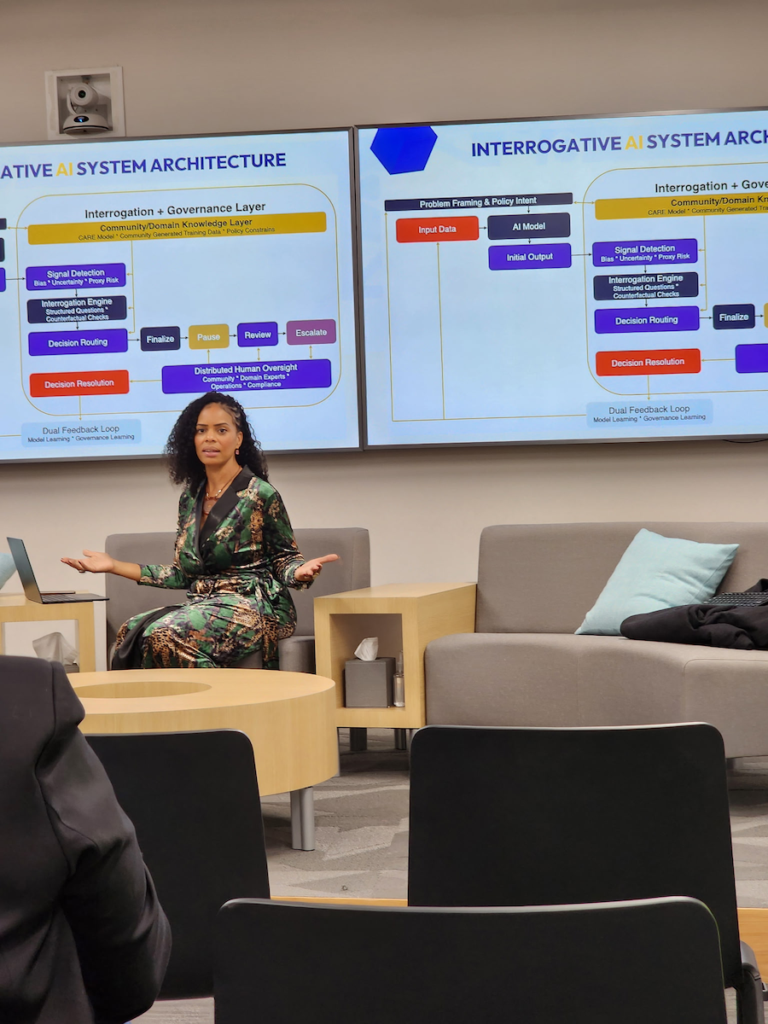
CRP: Could you share any examples of how you either have been able to apply this theory of interrogative reasoning or where you think it would be best applied?
MS: First off, the theory of interrogative reasoning is how communities govern artificial intelligence. It’s not just the reasoning for why they should govern artificial intelligence; it’s actually communities governing AI. It challenges the idea of human in the loop, because that human in the loop is just a person. I’ve been in rooms where the tech bros ask me, “Meme, tell me what skillset the human in the loop should have in order for them to manage a bunch of AI agents?”
That’s the human in the loop. It doesn’t make sense because you have one person with all their biases in charge of making decisions for a community of people. And that one person may not have ever had any proximity to harm or have any understanding of the harm that I experience as a Black woman that’s being oppressed by an algorithm. Proximity is the main prerequisite and people closest to the impact of AI understand the risks that that human in the loop may miss.
We’ve been able to TIR through the Measure CARE model. The CARE model is a widely used framework for evaluation. We created the CARE model alongside our community about seven years ago, with Huston-Tillotson University, incorporating several months of research and to better understand what we want research to look like in our community. CARE stands for community, advocacy, resilience, and evidence. Community is about who is impacted, who belongs in the decisions. Advocacy is about who holds the power. Resilience is about how we have survived this entire time, and how systems adapt without causing harm. And evidence is about data—how it’s used, what counts as data, who controls the data. We have been using the CARE model as our method of evaluating problems for quite some time. Measure has worked with over 109 organizations. Right now, we have a community of 13 organizations, meaning 13 different communities that are working on 13 different, very specific problems, whether their problem is the lack of Black girls in ballet, or it’s the lack of Brown boys who participate in gifted and talented programs, what we do is we apply the Measure CARE model to their problem.
The Measure CARE model is a 12-week, 12-step process, because everything good happens in a 12-step process. We already know that. They are partnered with a Measure evaluator, who is a community member, like me, who has gone through all our training in order to partner with one of these organizations to walk them through the CARE model. So, we’ve embedded the theory of interrogative reasoning into the Measure CARE model, simply said. Our focus right now is generative AI, large language models. How do we develop community created training data for large language models? Because right now there’s not much you can do to correct the biases in software like ChatGPT or Claude. Developers at these companies can do things at the system level, but if they don’t have accurate community-generated data where we say, “This is right and this is wrong,” and we come together as a body to deliver this information, then biases will continue to be perpetuated. Until they retrain or augment their training with actual living, breathing, human training data, we don’t have a chance to create a new system.
CRP: What really spoke to me is the relationships that we continue having with our neighbors and our community members and bringing those relationships into talking about technology and AI. You mentioned the issues with having a singular human in the loop is that you miss out on all these networks, and so it has to be expanded beyond that. Can you talk more about how you’re applying the CARE model and TIR with local communities?
MS: When we bring communities together to do the CARE model, we meet in 12 different meetings, the first meeting is the problem statement. The community with whom we work gives us their problem statement. For example, their problem statement is about adultification bias and how Black and Brown girls are adultified and treated as more adult than they should be. We take that problem statement, and we sit with the community with it. We feed that problem statement to a large language model.
We gather what the LLM has said about that problem statement, and then the community applies TIR. There are questions that the community uses to poke holes at that output. They say, “That wasn’t right. This is how they got it wrong. This is why they got it wrong. This is who is going to be hurt, because they got it wrong. This is the system that is going to be disjointed because this LLM has gotten it wrong.” Then the community basically rearticulates what the LLM gets right. From those utterances, from those groans, or from the frustrations, from the joy, from the pleasure that we hear as feedback, we gather that feedback. We haven’t generated or created our training data yet, but we’re collecting the feedback on what’s wrong.
So that’s one way right now that we’re applying it to the Measure CARE model. Once it goes through interrogative reasoning, then we come to a problem statement that is good for our community, that’s healthy for our community. Yes, we worked alongside the AI to get there. But it’s a problem statement that we can hold, that we believe to be true for our community. At the same time, we’ve been able to collect all the junk, so that we’re able to create training data that could hopefully help the next user get to a problem statement that’s more reflective of their needs rather than giving them the crap.
The second way that we’re applying it is en masse. We’ve had two, what we’re calling community in the loop convenings thus far. The first one was in Austin, Texas, on November 19. We brought together about 150 community members because the city of Austin is trying to define for themselves responsible and ethical AI. Measure successfully pushed them to start to have transparent conversations. Measure came in and applied our theory of interrogative reasoning questions. We provided AI literacy training. We also provided full transparency into the AI systems that the city is deploying, because communities had no idea before this.
Then we used our TIR framing to ask our community’s questions: “What does it mean? What does it look like for you?” We had another large-scale convening on December 2, with over 200 community members doing the same thing, asking them the same exact questions, using that TIR framework. In both cases, again, the goal wasn’t just about the feedback, but it was more about cogovernance. It was about shared authority. It was about making sure communities knew that they could interrogate AI, that they can have power over the algorithm, especially when they come together. We’re in this super-duper acceptance mode right now of AI. And people feel like they’ll miss out if they don’t use it.
Interrogative reasoning is not only about creating training data to make LLMs better, but it’s also about restoring power to ourselves. AI is not smarter than a human. What we’ve heard from the community after having these large convenings is that they want to be engaged early on. They don’t want to be engaged after a law or policy is passed. They want their lived experience to be looked at as valid and as data.
They want to help to define the ethics that govern AI for the city. They do believe that education is power when it comes to AI. Literacy matters to them. And that the more that they are in the loop, the more trust they will have in the entity that is pushing AI on them, because right now AI is being pushed on us. They will form a better, healthier relationship with AI if they trust in the process. They don’t just want to have a voice in it, but they also want to have accountability and policies that stay and stick.
CRP: Thank you for that detailed breakdown. It was very illuminating. What future work do you see yourself participating in with TIR or with your other work at Measure?
MS: I see interrogative reasoning being an opportunity for businesses to do better. At the end of the day, I believe if people would just hear me when I say human in the loop is not enough, and in fact, a human in the loop is dangerous. But humans, plural, in the loop who have proximity to the problem being solved, whose feedback is honored and believed. And humans in the loop that share their feedback at the appropriate time, because timing is incredibly important to the theory of interrogative reasoning. If they share it at the appropriate time, then systems can be changed.
Because there will be a time when, just like Dr. King said, it will be too late. There is a fierce urgency when we talk about generative AI and the boom of AI tools. These systems are being built and deployed without any indication that there is a better way to create the system. They’re trying to do it as cheap as possible. Why this matters right now is because systems that are built without TIR are not going to be sustainable. Community governance has to build a long-term, real, truthful, trustworthy process, and they will not do it well unless they apply interrogative reasoning and bring communities in the loop.
The future is human. The future is not AI. The future is humanity. We are going to want to know how real a system is and the process it took to get there. We’re going to want to know how authentic a system is.
This interview has been edited for length and clarity.