
Looking In from the Outside: A Conversation with Ingrid Burrington
Looking In from the Outside: A Conversation with Ingrid Burrington
In this conversation, Just Tech Fellow Todd Whitney speaks with artist and writer Ingrid Burrington about demystifying what technology makes invisible, their unexpected paths into journalism, and the importance of bringing levity and humor to serious work.
Todd Whitney (TW): Ingrid, thank you for taking some time to sit with me. I had this opportunity to interview somebody whose work has stuck with me. Recently, I’ve been thinking about how a lot of what I do is informed by some of your work from back in the day. One of the things that I’m trying to figure out right now is whether to enter a PhD program, though for the longest time, I’ve pushed back against it, because I don’t want to go through that crucible. Since you recently finished your PhD in January, what did you study and what was your experience?
Ingrid Burrington (IB): So, in 2020, a lot of stuff was going on in the world and in looking at the state of things I decided that maybe it was time to do what everyone had been telling me to do for many years and earn a doctorate. I avoided it mostly because I had heard enough horror stories about doing PhDs, even from people who are tenured faculty.
I was pretty deliberate in how I approached it, mostly knowing that I wasn’t going to move and I didn’t really have high expectations of getting into a tenure-track position. There were research projects that I couldn’t do with the resources I had at the time. There were things I wanted to use that I knew I couldn’t access by myself. And there was a threshold of legibility that I was hitting, and with a recession coming, having some credential armor would be a safe bet. So, I ended up connecting with a geography professor at the University of Delaware.
I don’t think I had necessarily the classic PhD experience of bonding with a cohort and being really into being at school. It’s hard in your 30s to go into a new setting and make it your personality. I already had a career and a life outside academia.
For the master’s thesis part, I researched the supply chains of early twentieth century electronics manufacturing. At this point, everybody knows about the rocks in computers in the twenty-first century. There are active campaigns around the horrible conditions in mines around the world and all the stuff that goes into electronics. But something that has always perplexed me in the framing of these conditions is it’s either framed as this very current problem—like Apple showed up and things got really bad in Central Africa—or this sort of deterministic longue dureé history thing, like conflict minerals in phones are because of King Leopold. Both framings seemed like oversimplifications of what had to be a richer history. So, I started looking into what early electronics manufacturers were doing in the twentieth century. But their papers are scattered across multiple different institutional archives, if they’re archived. And nobody kept receipts on like, material sourcing in the 1960s.
So, my hack on this was looking at changes in mineral supply chains to the United States during World War II, which meant going to the National Archives in College Park, Maryland, and looking at records of American dollars and resources going into the building out of mines for high-purity quartz, tantalum, and mica and other stuff for electronics of that era. With those archives and old news coverage and company documents that you could find on the Internet Archive, I tried to piece together where these materials were first sourced.
High-purity quartz in the first silicon semiconductors was most likely coming from Brazil until about the 1970s.[1]Ingrid Burrington, “From War Crystals to Ordinary Sand: Excavating Silicon Supply Chains,” IEEE Annals of the History of Computing 46, no. 2 (April–June 2024): 13–23, … Continue reading For tantalum, sourcing was divided between Brazil and what was then still called the Belgian Congo. Due to the Congolese independence movement and coup, tantalum falls off and doesn’t become a commodity in Congo again until the 2000s during the Congo Wars.
I had started to put together the Brazil stuff a year or two before I started grad school. But there’s a huge difference between putting together this little line of inquiry independently and being able to say the IEEE Annals of the History of Computing has approved of this research, and it has been peer-reviewed.
I’m really happy to have been able to do that research in grad school because so much of the history of computing is framed as this very American story. It’s understandable why that happens, but when you take this international mineral supply chain into account as being part of it from the very beginning, it becomes a very different narrative, and I wanted to communicate that different narrative with a really strong paper trail.
TW: You’re somebody who takes such in-depth looks at other things and systems; personally, it can be a little bit difficult to talk about what I do, especially with all the different threads. Can you give us your Wikipedia page, in your own words?
IB: Once, when I was an adjunct, my students were impressed, like “You have a Wikipedia page?” Yes, and I’m getting paid $3,500 to teach you, so let’s move on.
I have been writing, teaching, and making art about and around computers since probably 2013. For my undergraduate art school education, I was a printmaker, though in some ways I was a writer who went to art school. I did a lot of zines and book art stuff. I didn’t grow up a computer person. I had a strong interest in power and systems and why things are a certain way, which increasingly meant looking at computers.
Around the mid-2010s I started doing a lot of freelance journalism—a lot of it explainers about internet infrastructure, the physical conditions of living with a computer, living in a big computer as hardware miniaturization and networking terraformed the planet.[2]Ingrid Burrington, “Terraforms–Or, How to Talk About the Weather,” DING, no. 2 (2019), https://dingdingding.org/issue-2/terraforms-or-how-to-talk-about-the-weather/. I’ve organized conferences; I cowrote a novella; I have made little sculpture-type work, but, fundamentally, the written word is the base for me.
My one-sentence artist statement for a little over a decade has been that I write, make maps, and tell jokes about places, politics, and the weird feelings people have about them. Computers play a big part in the work, because they’re a nexus of power, but I didn’t really set out thinking I wanted to live at the intersection of art and technology. It’s more a place I wandered into as the technology became more and more part of everything.
TW: That’s what I find so captivating about your work. After college, the Great Recession hit and I was wondering how do I figure stuff out? I couldn’t get any projects started, so I worked as a reporter for NPR for a number of years, but it got a little bit old for me, because I realized a lot of people say the same thing. As a reporter, you aim to hold power accountable but those allegedly with the power don’t say anything of interest.
I’m interested in your thoughts on the benefits of being somebody who doesn’t have a background in technology or coding but started to explore and develop formative ideas around infrastructure and power. What’s lent to that type of investigation whenever you take that approach?
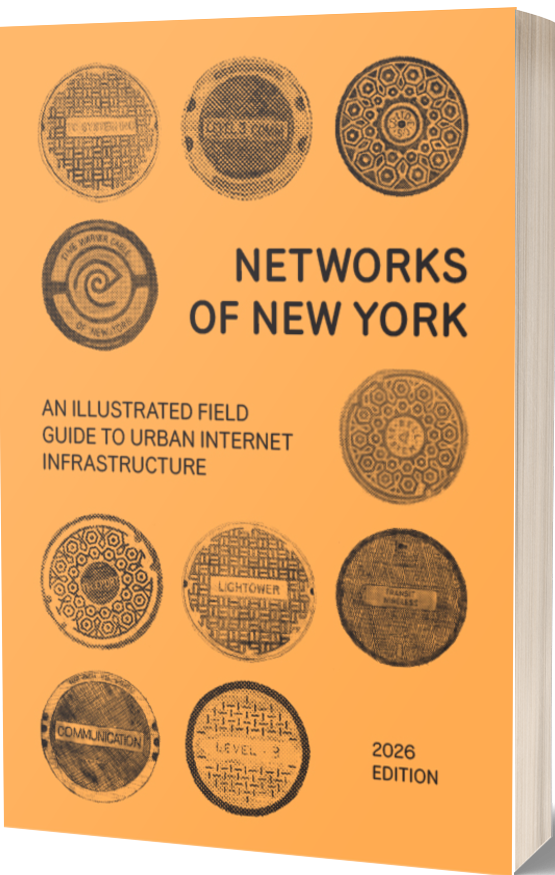
IB: Some of it is just following my own curiosities. I’ve been reflecting a lot while returning to the infrastructure work. Networks of New York is out of print, so I’m doing a new edition of it, a self-published revision. It’s so different to talk about the dissolving of the gap between internet and real life in 2026.
Ten years ago, I had to explain to people what a data center was. I had to be persuasive that it was something worth knowing about. I think I was drawn to that stuff in the 2010s, because it did really feel like that was a period when the gap was closing. The internet still had this aura of frivolity to a certain amount of mainstream audiences, though by 2015–16, people were getting fired or being rejected from college for social media posts and political movements had been organized on the internet. All of these things were already happening, yet there was still a sense of the internet not being serious or there being a distance between the online and everyday “real” life.
Today, the veil is completely gone, and it totally sucks. You’re very aware that the internet and real life are interchangeable when you go to Washington Square Park and it’s full of content creators trying to man-on-the-street you with a microphone. People’s livelihoods are increasingly bound to social media. Every restaurant needs to be perfectly Instagrammable. There are all sorts of weird ways it manifests in public spaces now compared to a decade ago.
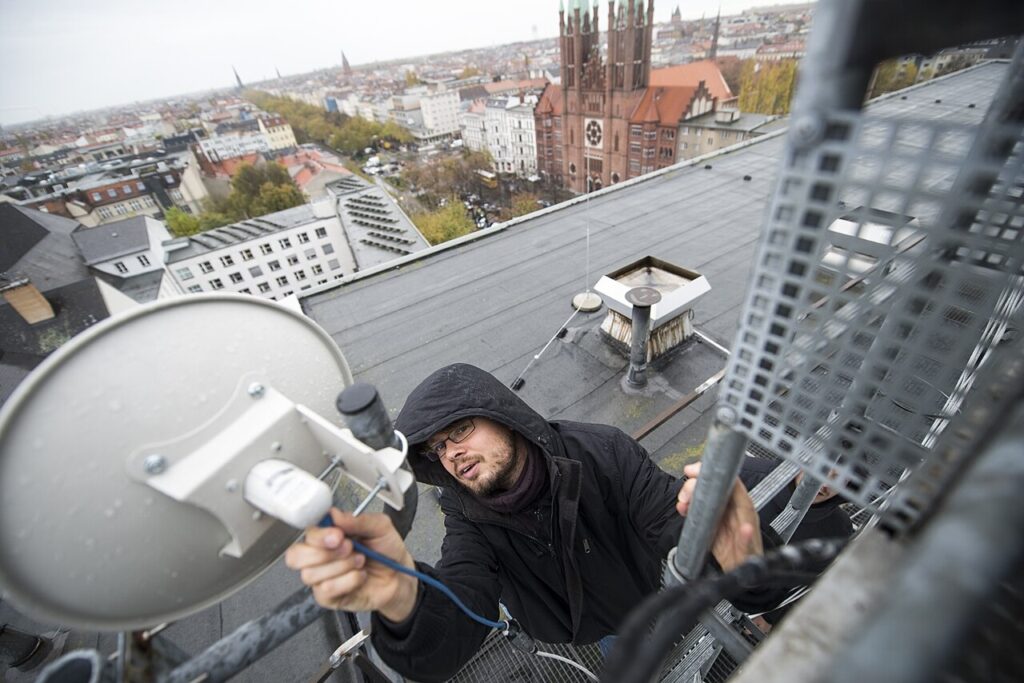
There is still an amount of the internet that is outside of everyday people’s control. But it’s all the product of decades of human labor, ongoing labor, maintenance, and the histories of these platforms and technology are very much stacked on top of other histories. There were a bunch of other things that inform our present. In New York City, there’s a lot of stuff from that especially. Some of what I’m trying to do with this new edition of Networks is reckon with that and showcase cool stuff that people have been trying to do online over the next decade in New York City. NYC Mesh was a handful of guys in 2015 who were putting up antennas in the East Village, and now they’re basically a small internet service provider (ISP) across at least three boroughs. I feel bad I didn’t include them in the first version of the book.
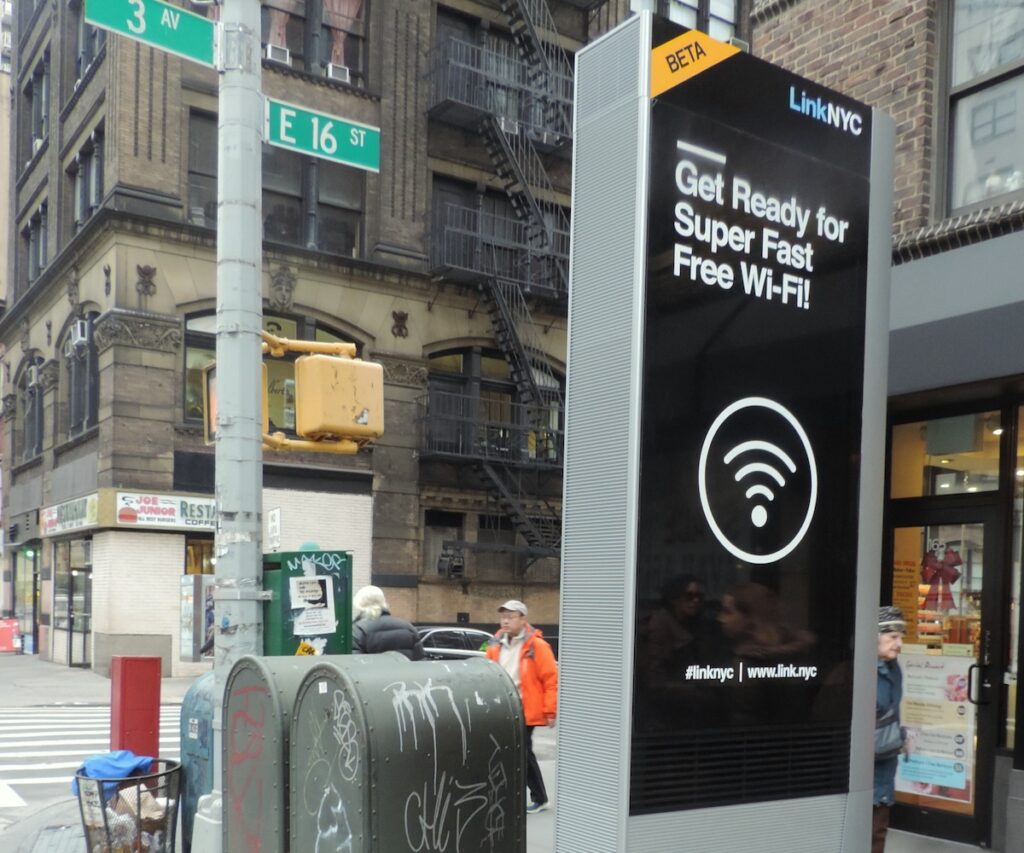
The city’s Department of Housing Preservation and Development has been working with NYPL on a program to basically build their own internet backbone for low-income housing residents. That’s dope. That’s really exciting. On the other end of that, you have LinkNYC, which aimed to bridge the digital divide. Instead, we have ads on screens. It’s useful to look at the different ways the internet could be governed and implemented as a part of people’s lives through different municipal projects like these.
TW: I hear that. I love that point about the non-inevitability of a lot of what we take for granted. Networks of New York was my first touchstone with you. I want to bring that up really quickly because one of the things I still reference is the field guide, like a companion. I really like having this sturdy little book to hold onto and being able to just reference it.
Even though I read a lot [of books], I’ve weirdly found myself gravitating more toward field guides. They tend to open things up for me in a different way. There just seems to be more possibilities present with a little field guide that I can carry with me. Field guides offer a lighter touch than other books, while also promoting that we engage with the world around us. With all the different projects that you do and the different research topics you investigate, how do you decide and figure out what might be the most appropriate form to share it with the world?
IB: Shannon Mattern has some really good writing about the field guide as form in a digital era.[3]See, for example, Shannon Mattern, “Cloud and Field,” Places Journal (August 2016), https://doi.org/10.22269/160802. Part of what’s so compelling about the field guide to me as a form is that I want people to go outside. Field guides make you look at where you live differently. You have this new lens through which to experience public space, and that’s such a delight, attuning yourself to other kinds of experiences. It’s very easy, especially in a big city, to put blinders on to get through your day.
When choosing what forms best function for a project, some of it comes down to how to best translate what I’m excited about. The field guide partly emerged out of me making my friends stop and look at stuff with me on the street. But me pointing at stuff doesn’t scale. I have done these ad hoc internet infrastructure walking tours—I’ll probably be doing them the rest of my life—but with the field guide everyone can do them. There’s a guy who made a Networks of Philly. I love that. For some projects it’s also the serendipity of how a project happens. The novella project, titled The Training Commission, was a newsletter I started with Brendan Byrne as a joke I made on Twitter. He wrote a short story riffing on the joke and I said, “This is fun. What if we built this out a little bit more?” And it turned out collaborating with a fiction writer was really generative. It sounds a little bit like we had similar experiences of not setting out necessarily to be journalists and then some things happened.
TW: Yep, life happened.
IB: Which is funny because both of my parents worked in TV news and my grandparents worked in newspapers, so I should have been more drawn to it. I still bristle at calling myself a “real” journalist—I didn’t have the training; I was just someone who wrote a lot. But it was a very useful persona to cultivate for getting inside a Facebook data center, for example. If I were some unknown artist, you’re not going to get a reply. Media requests from The Atlantic get a very different response.
TW: My Just Tech fellowship work is built around demystifying air quality and focusing on how indoor air quality impacts people. But journalism is what brought me to this work. When I was at the Brown Institute for Media Innovation at Columbia, a couple of newsrooms came to us looking to design a special feature project on air quality in Salt Lake City that documents the ways that the city’s resident experience different levels of air pollution due to the city’s legacy of redlining. But the only available data were coming from publicly available air quality monitors like Purple Air.
To me, it didn’t make sense to use that type of data for storytelling. So, I fabricated a prototype and calibrated my own network of air monitors. We got them into people’s homes and then started our reporting process by working with people—getting them to better understand what was going on around them, in their own homes. Because one of the big hiccups when talking about air quality is that nobody really has anything interesting to say. So, there’s not a terribly large vocabulary, and I don’t think that’s by accident. We’ve been taught to not think about air until it’s really bad. And then, the vocabulary that we have is incredibly limited: good, bad, hazardous for sensitive groups. It’s really just five or six descriptors.
When you get one of my bad boys in your home, I tell people to not pay attention to the number. I try to get people to speak to the gap that exists between the data that we’re collecting with air quality monitors and people’s own internal narratives about what is happening in their homes at any given point. It’s been pretty cool to see the way people learn about air quality; everybody comes at it with their own language, which is important to me—to express a large vocabulary around these types of topics.
I love the idea of narrativizing and technology. A lot of what you do has to do with narratives and myths, but a lot of it seems to be the stories that we share with each other and collectively buy into.
IB: That’s super cool work. In the world of demystifying-type projects, there’s often an unhealthy reliance on the trope of invisibility, “making visible the invisible,” so I really admire work where you are in fact dealing with stuff that is imperceptible to the human eye.
The number of things that are either literally invisible—wireless signals, air quality—and the things that are just obscured or rendered abstract lends itself to the narrativizing of technology. It is partly about trying to make it legible at a human scale or at least making a larger system legible.
On myths: there’s a whole little sub-pocket of work I was doing back in the 2010s that was about and around magic. In 2016, Meredith Whitaker and I were part of Rhizome’s Seven on Seven (7 x 7) commission program, and we made a website that was the text of a sixteenth-century spell book with these sigils that I designed, just riffing on John Dee with a lot of Bodoni.
The framing was that all of these were texts about core internet governance and infrastructure written in a goofy Renaissance-era magic textbook tone. The guilds were actually ICANN, or the unique runes were Internet Protocol version 4 (IPv4). I feel like it landed a little flat at 7 x 7 because you’re dealing with the audience who’s like, “We don’t know what any of this stuff is.” We were cracking up because Meredith was still at Google and was doing a lot of work at the level of core governance bodies and Internet Engineering Task Force (IETF)-type stuff, the layer that does get joked about as being all the old wizards.
I love a little guy with a cloak doing spells type story, but at the same time I don’t love how treating tech like it’s just magic becomes a way to justify or reinforce having power over other people. That’s one sort of example of narrative.
TW: In a similar spirit—you already hit on it a bit—but I love some of the ways that you approach these topics with a sense of humor and uncanniness. How does that impact thinking about these systems that might be somewhat imperceptible to us even if they’re right in front of us and that we’re interacting with every day? What’s that approach to leveraging humor, uncanniness? How does that promote intimacy and understanding for you?
IB: Oh, that’s a really nice way to put it. I default to jokes. Some of that’s maybe just an unwell-coping strategy for the existential realities of everyday life. But circa 2013–14, there was definitely a very serious vernacular in a lot of computer art and tech spaces that partly came out of stuff like the Snowden documents, which were arguably not taken seriously enough. But that very serious “encrypt all your stuff” hacker-aesthetic work weirdly fetishizes the surveillance and kind of makes people feel powerless. When you take it so seriously, it lends itself to a little bit of catastrophism. Don’t get me wrong, the vibes are not great, but the vibes have not been great in many periods of human history and people still laughed and made jokes. If anything, the ability to keep laughing is what keeps people going.
TW: Yeah, part of my process when working with people who have my air quality monitors in their homes, deliberately stepping aside and letting them figure it out. If I see you have dangerous ground level ozone or carbon dioxide levels, then I’ll say something.
But if the situation is okay, I prefer to just let people stumble through it for a while. That’s part of the process of learning, of getting a sense of how you feel and understand respiratory regimes in your home at any given moment of the day. Whether it’s humor or letting people fumble and fall on their ass a little bit as they’re trying to figure stuff out, at least to me, that’s proven to be a necessary thing.
IB: There’s also the humility with which one carries oneself. There’s this long legacy of this spectacularized charismatic mega infra—infrastructure as this kind of sublime, awesome thing to be conquered. “Behold, I found it” kind of work. The Neal Stephenson essay, “Mother Earth Mother Board,” where he talks about being a hacker tourist and the cover—in a talk I gave in 2016 I had a slide that was the cover of that issue of Wired and then the Casper David Friedrich painting of the guy staring at a mountain.
It’s all the same conquering hero narrative, which is tied up in exoticizing the frontier and colonial conquest. At the time I was really into talking about being a pilgrim instead of a tourist, someone on an almost spiritual journey to gain a sense of respect and honor for the thing I’m trying to learn about. And again, you’re going to make jokes. The Canterbury Tales were about a pilgrimage and were also really funny. Having a bit of humility and being able to make jokes. That’s part of the process.
This interview has been edited for length and clarity.
Footnotes
| ↑1 | Ingrid Burrington, “From War Crystals to Ordinary Sand: Excavating Silicon Supply Chains,” IEEE Annals of the History of Computing 46, no. 2 (April–June 2024): 13–23, https://doi.org/10.1109/MAHC.2024.3378121. |
|---|---|
| ↑2 | Ingrid Burrington, “Terraforms–Or, How to Talk About the Weather,” DING, no. 2 (2019), https://dingdingding.org/issue-2/terraforms-or-how-to-talk-about-the-weather/. |
| ↑3 | See, for example, Shannon Mattern, “Cloud and Field,” Places Journal (August 2016), https://doi.org/10.22269/160802. |