
From Studio to Study: Artistic Research on AI and Society
From Studio to Study: Artistic Research on AI and Society
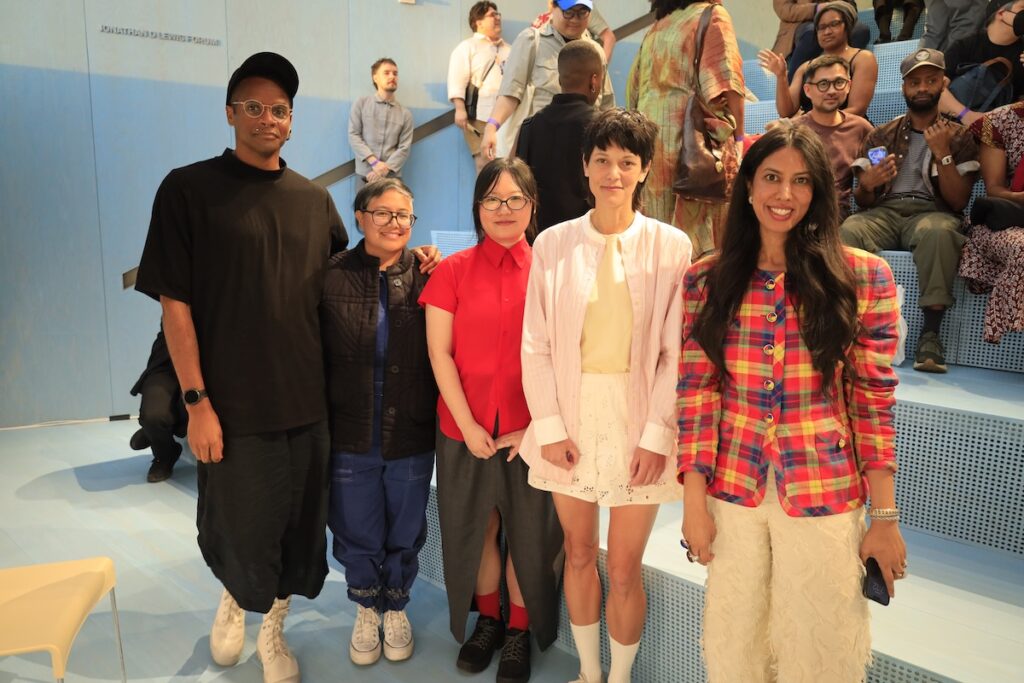
This essay reflects on “From Studio to Study: Artistic Research on AI and Society,” a public conversation organized by NEW INC and the Social Science Research Council’s Just Tech program and held at the New Museum. Moderated by Nabiha Syed of the Mozilla Foundation, the discussion brought together Romi Morrison, Lauren Lee McCarthy, Dorothy Santos, and X. A. Li to explore how artists are engaging with the social impacts of AI.
Artificial intelligence is built to resolve ambiguity, classify, and predict. Yet the systems it produces cannot hold contradiction or account for the specific texture of a life. Artists work inside that gap by investigating the choices woven into these systems, and the choices we make or fail to make when using them. In “From Studio to Study,” artists Romi Morrison, Lauren Lee McCarthy, Dorothy Santos, and X. A. Li do not stand outside AI and computational tools offering critique. They work inside them, breaking and building, producing knowledge that technical research alone cannot.
What follows traces that argument through three ideas that emerged from their conversation. The first focuses on how artistic practice functions as a mode of investigation, revealing what is embedded in technological systems. The second looks at agency and how people surrender it willingly, in exchange for convenience. The third examines how art can hold what AI cannot: ambiguity and knowledge that resists quantification.
Revealing through Creative Practice
Throughout the conversation, each artist described their creative practice as a form of investigation. Research means having a question about the world and pursuing it systematically; for these artists, that pursuit runs through performance and participation. They find that these systems distribute power and vulnerability in particular ways, and that corporate truths about AI are partial and contestable. People are neither passive users nor inevitable subjects of these technologies. Three of the artists’ practices illustrate this.
Santos’ project, Infrastructure of Feeling, takes up emergency response systems, the infrastructure that decides who gets helped in a crisis. By excavating the human labor and institutional histories embedded in these networks, she shows that every technical system encodes choices about who bears responsibility and who bears risk.
Li’s performances and installations start from something corporations would rather not admit: that there is no singular truth about AI. Their installation, Consensus, applied off-the-shelf crowd-counting and captioning algorithms to a museum’s galleries, generating machine descriptions of visitors that were often wrong yet accumulated into a settled record. Visitors could compare the captions with the room they were standing in and notice the mismatch. With this work, Li shows that when we push these tools into unfamiliar territory, using them in ways their marketing never specified, we are already investigating them.
Morrison’s work is less concerned with exposing what technology does wrong than with shifting what people believe they can do. Their performances unfold through initiation, inviting participants into relationships with one another and with the technologies of ceremony rather than positioning them as passive users. This is a practice that asks people to move from critique into participation, from asking what technology is doing to us toward what we might do in response.
Agency and the Power to Refuse
Another thread running through the conversation examined agency as something we surrender through the small accommodations that make these systems easy to use. What follows from that surrender is an inability to recognize the extent of what we have ceded. McCarthy makes this visible by replacing the machine with human action, while Li highlights what disappears when a workplace death becomes a data point.
McCarthy’s AUTO performance invites participants to reckon with what they are willing to give up to arrive at their destination. In a self-driving car simulation, a human impersonating AI asks passengers where they want to go, creates a song based on the chosen destination, and then asks them to sing along. Only when participants begin singing does AUTO come to life. Prompts from the dashboard instruct passengers when and how to sing and dance, mirroring a family car trip. Unless passengers give up control, AUTO never moves. In an increasingly automated society, McCarthy teaches us how power operates through technological systems in everyday experience. Her work invites us to ask whether being on autopilot is worth the control it costs.
Li’s FULL-TIME, an installation built from government records of workplace injuries and deaths, examines how human tragedy is reduced to numeric codes. Voices read each record aloud, algorithms distort human figures on screen, and viewers are invited to enter their own daily activities into the same clinical forms, their routines joining the register of injuries and deaths. As AI systems grow capable of acting on our behalf, Li argues, what is at stake is our capacity to recognize a human reality inside the data.
Art, Ambiguity, and Feeling
Another contribution artists make to conversations about AI is their willingness to leave ambiguity unresolved. AI creates the impression of a world that is predictable and precise, while flattening the complexity of lived experience. The panelists argued that art makes room for contradiction and feeling, allowing us to engage technology not only as a technical problem but as a social one.
McCarthy’s projects put her own body where tech companies put a machine. In LAUREN, she became a human smart home assistant, watching over participants around the clock and controlling their lights, locks, and music. In Surrogate, she offered her body for monitoring via an app, with someone else dictating what she ate and when she slept. The discomfort is the point of both performances. We give devices permissions we would never grant a person, and McCarthy’s work shows how thoroughly we have learned to accept that surveillance and control over our lives and bodies.
Morrison’s woven textile sculpture, The Future Conditional: 00_ To Create Love With Dry Eyes, asks participants to give over their attention and accept the absence of an accessible message. As participants walk behind the textile curtain of the cylindrical structure, they are met with voice recordings whose meaning does not come quickly. Most people, Morrison noted, leave before it arrives, and that impatience is what the work asks us to notice. Morrison invites a slower, more deliberate form of engagement than automated technology allows and argues that our dependence on predictive systems threatens relationship-building. The same technologies, they added, have historically been weaponized to deter Black political change in US cities.
Santos’ work emphasized questions of language and identity that resist quantification. Her multilayered game, The Cyborg’s Prosody, was inspired by accent-reduction programs used by call center workers. Participants must pronounce Tagalog words, progressing from accented English to fluent Tagalog, to advance to the next level. Santos, who used her mother’s own voice as the model for speaking Tagalog, explained that some participants felt uncomfortable at what they perceived to be the racist way they were copying her voice. That discomfort inverts the experience of Filipino call center workers, who must lose their accents to appeal to English-speaking consumers. Santos found the AI and machine learning components less interesting than the human dynamics surrounding them: codeswitching, affect, and community building.
Knowledge Beyond Experts
Morrison, McCarthy, Santos, and Li challenge the notion that expertise belongs exclusively to tech companies and their staff. They demonstrate how artistic research can reveal the choices, assumptions, and power relations embedded within these technologies, allowing us to understand and resist the top-down model of implementation of novel technologies. The tools and knowledge to make and break these algorithmic systems are within reach, and the first step is to question the need for technology in every aspect of human relationships.

